
Case
22 Jun, 2026
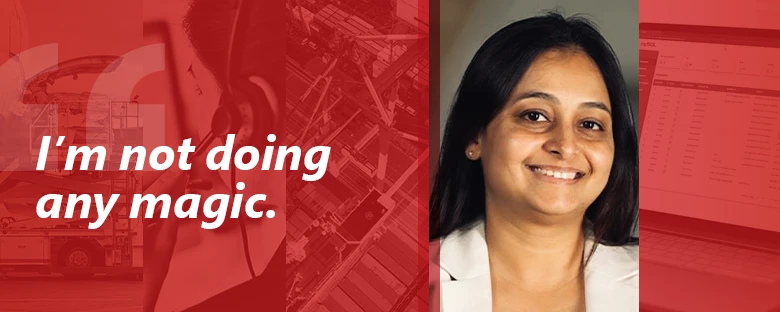
Lathika Panangad, Regional Program Manager, Operations, EMEA, Scan Global Logistics
I’m just monitoring the shipments every day and updating the customer before they ask.
That is how Lathika Panangad describes part of her role as Regional Program Manager in Dubai.
Simple, perhaps. Easy, not quite.
Lathika works with global accounts across the Middle East and Africa, serving as a single point of contact for customers when questions concern operations, processes, systems, costs, escalations, or new solutions.
That matters when something changes.
Customers do not want to chase five different answers from five different places. They need one clear picture of where their cargo is, what is happening, and what comes next.
For Lathika, that applies whether it is one shipment or 100. Cargo has to move, decisions have to be made, and someone has to stay close to the details before the customer has to ask.
Over time, that consistency builds trust.
Not because every issue can be solved immediately, but because the customer knows who is following up, where the answer is coming from, and what is being done next.
Turning scattered updates into one clear picture
During recent challenges in the Middle East, both airfreight and ocean freight shipments have been affected by changing routes, limited visibility, alternate ports, and additional costs.
Some shipments are stuck in transit. Others are offloaded at ports that were not part of the original plan. In some cases, even carrier systems don’t show the full picture right away.
For Lathika, that uncertainty has become part of the daily reality for logistics teams in the region.
And for customers, the pressure is clear.
Their cargo still needs to move. Their internal stakeholders still need answers. Their timelines may still be critical, even when the market changes around them.
In those situations, the work becomes very practical: finding out where the cargo is, checking with carriers and airlines, exploring alternative routes, documenting added costs, and explaining the next realistic option.
Sometimes, you should have three eyes. You have to look everywhere and be able to find quick solutions.
When system updates are missing, the team calls. When cargo is offloaded at an unexpected port, they check what it means for the next leg. When costs change, they document why.
That does not remove every disruption, but it gives customers a clearer view of what is happening and what can be done.
Why logistics is still a people business
Lathika returns to one point several times: ‘Logistics is still a people business.’
Technology, systems, and reports help. But when cargo is stuck, when a carrier update is missing, or when an urgent answer is needed, relationships still make a difference.

‘No matter how technology improves, relationships and having the right network are absolutely essential,' she says. 'That is what makes a difference in this business.’
That network reaches across internal teams, carriers, airlines, suppliers, partners, and customers. Someone has to connect the right people, keep the tone constructive, and turn scattered information into the next step.
For Lathika, that starts with understanding the customer’s requirement before bringing forward a solution.
‘It is about understanding customer requirements and then bringing solutions to them, rather than selling your product directly.’
Sometimes, that also means helping customers see the reality behind the timeline: what is happening in the market, what can be controlled, what cannot, and what the best available option is.
This is where the everyday work becomes visible.
Not as magic. Not as a heroic one-off.
But as daily monitoring, clear communication, careful follow-up, and the ability to act before the customer has to ask.



 Login
Login